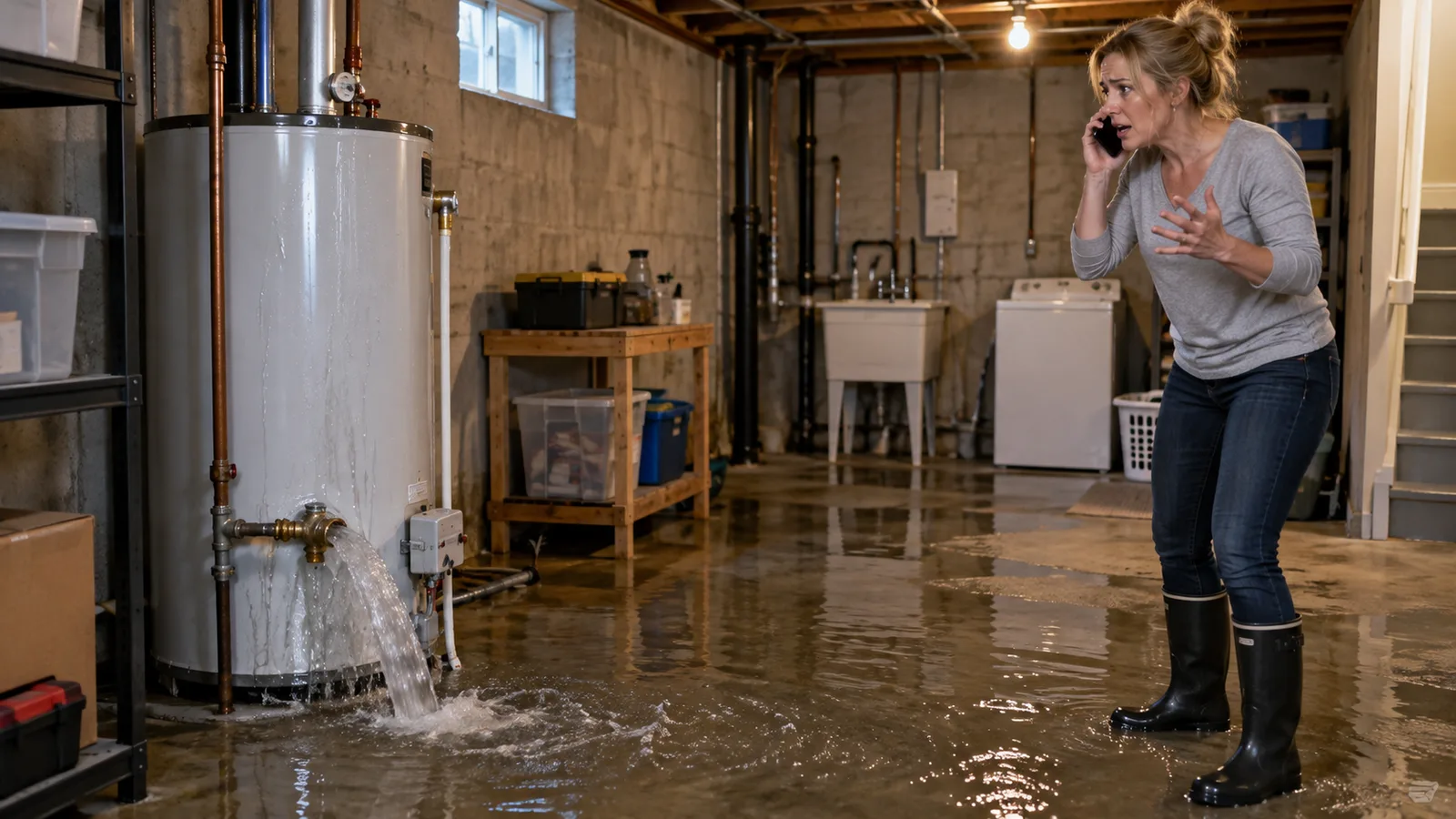
Do you need a permit to replace a water heater here?
Almost always yes — and the office that issues it is your township or borough, not Bucks or Montgomery County. That surprises people, and it is the single most common reason a straightforward replacement turns into a phone call nobody expected.
- Independent local contractors
- A cost range in about 60 seconds
- Free — contractors pay us, not you
- Offer times you're home, if you like
Get your estimate
A few questions about the job, a range in about a minute. No sign-up.
What do you need help with?
Takes about 60 seconds · No obligation · A range, not a quote
The short version
A permit is required by default. Replacing a water heater touches the water supply piping, and Pennsylvania's construction code specifically excludes that from the work you may do without one.
Your township issues it, not the county. There is no single county permit office for this. The rules, the fee and the inspection schedule are set where you live.
An emergency does not mean no permit. It means you may replace first and file after — within three business days.
Well and septic go the other way. Those permits are county-level. A job that touches both needs two offices.
Why the permit is municipal and not county
Pennsylvania's Uniform Construction Code sets a statewide floor, but it is administered locally. More than 90% of the state's 2,562 municipalities enforce the code themselves, each running its own office with its own fees, forms and inspection scheduling. Every municipality in Bucks County has opted in. So the practical answer to "who do I call" is your township or borough building department — and two houses ten minutes apart can genuinely face different paperwork.
There is a wrinkle worth knowing about. Municipalities that adopted the code before 1999 may carry local amendments that go beyond the state baseline, and the state says openly that it holds no record of what those amendments are. There is no central place to look them up. Whoever pulls the permit has to ask.
What the regulation actually says
The relevant text is 34 Pa. Code § 403.62, which requires a permit for the installation, enlargement, alteration, repair, removal, conversion or replacement of any electrical, gas, mechanical or plumbing system.
There is an exemption for "ordinary repairs" — and this is the part that decides the water heater question. The exemption explicitly does not cover adding to or relocating water supply piping, sewer or drainage piping, electric wiring, or mechanical work. A water heater replacement touches the first of those on both ends. It is not an ordinary repair under the regulation, whatever it feels like from a ladder.
The same reasoning is why a panel upgrade, a generator, an HVAC replacement and a bathroom remodel all default to permit-required in these two counties.
The emergency exception, and what it is not
If the tank has failed and the house has no hot water, you are not expected to wait for an office to open. The regulation allows the replacement to proceed and the permit application to follow within three business days.
That is a filing window, not a waiver. The inspection still happens, and the work still has to pass it. A contractor who tells you an emergency means no permit is telling you something the regulation does not say — and it is your house, not theirs, that carries the unpermitted work when you sell it.
What this means when you are comparing quotes
Ask every quote the same two questions: is the permit included in this number, and who pulls it?
Both answers vary legitimately. Some contractors fold the fee in, some list it separately, some expect the homeowner to file. None of those is wrong. What matters is that you find out before you compare two numbers that are not measuring the same thing — a quote that quietly excludes the permit will always look better than one that includes it.
It is also reasonable to ask for a Pennsylvania home improvement registration number. Anyone doing more than $5,000 a year of this work is required to hold one, numbers begin with "PA", and the register is public and searchable.
If the house is on a well or septic
Then a second office is involved, and it is the county one. Sewage and on-lot well permitting run through the county health department rather than your township — the exact inverse of the building permit. A water heater alone will not usually trigger it, but anything that touches the drainage side can.
Don't guess what your project will cost.
Answer a few questions and see a range for your house before anyone calls you.
Common questions
Can I replace my own water heater in Pennsylvania?
A homeowner may generally do work on their own primary residence, but the permit requirement does not disappear because you are the one holding the wrench. The work still has to be permitted and inspected under 34 Pa. Code § 403.62, and it is your township that issues the permit.
How much is a water heater permit in Bucks County?
There is no single answer, because the fee is set by each municipality rather than by the county or the state. Your township or borough building department can tell you in one phone call.
What happens if the water heater was replaced without a permit?
It usually surfaces at resale, when an inspection or a title search turns up work with no record. Municipalities generally have a process for permitting existing work after the fact, which typically costs more than the original permit would have and may require opening something back up so it can be inspected.
Does an emergency replacement still need a permit?
Yes, but you may do the work first. The regulation gives a three-business-day window to file the application afterwards. The inspection still takes place.
Related guides
All articles → Article
How hard is the water here, really?
Horsham averages about 16 grains per gallon — squarely 'very hard'. Buckingham runs 7 to 10. What those numbers do to a water heater, and what is worth doing about it.
 Article
Well and septic: the one permit that is not municipal
Building permits in Pennsylvania are issued by your municipality. Sewage and well permits are not — they go through the county health department. Which office you need, and when.