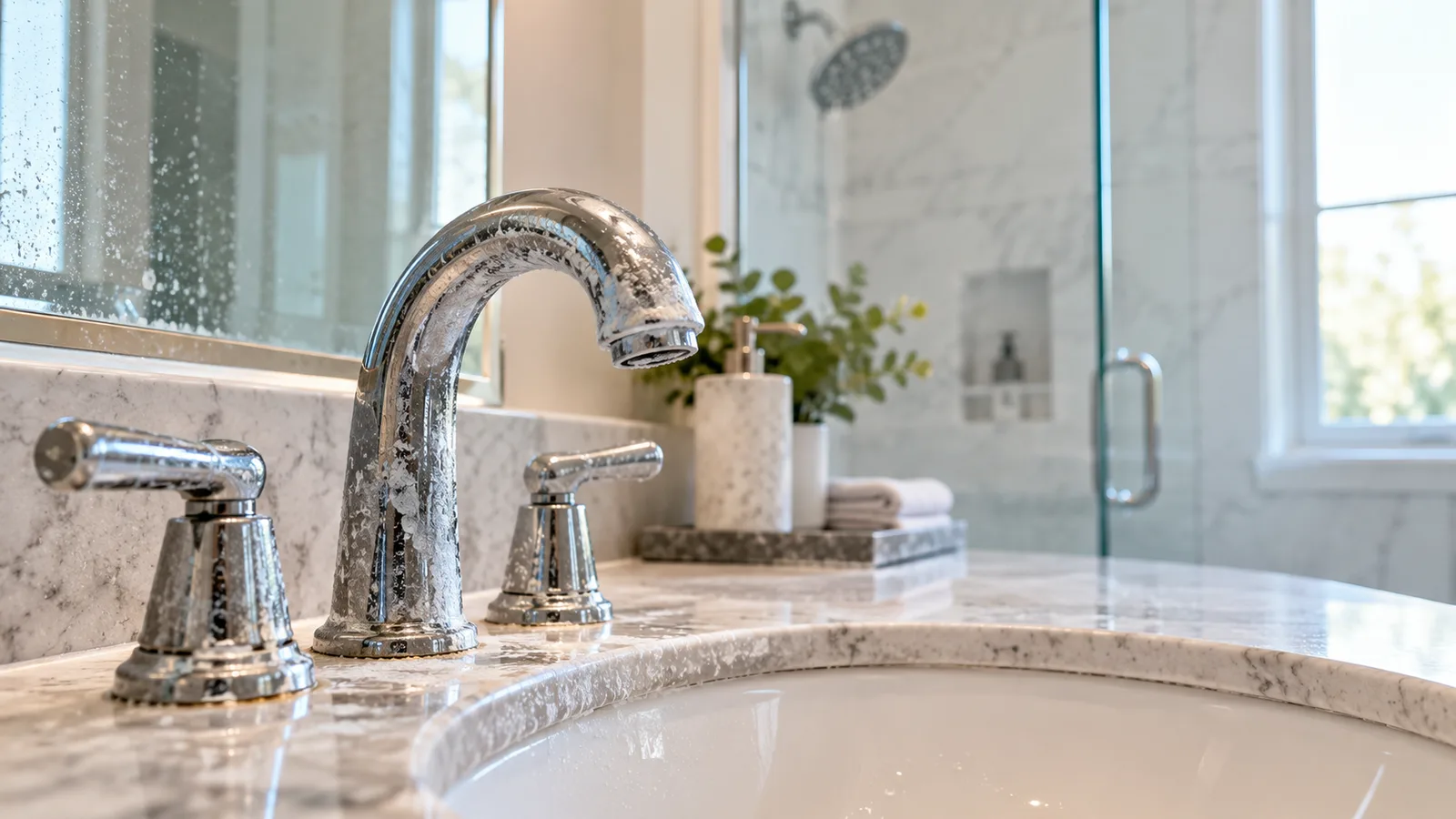
How hard is the water here, really?
Hardness is one of the few things about your water that your utility publishes and that you can act on. Two systems in this area publish theirs, and the numbers are far enough apart to lead to different decisions.
- Independent local contractors
- A cost range in about 60 seconds
- Free — contractors pay us, not you
- Offer times you're home, if you like
Get your estimate
A few questions about the job, a range in about a minute. No sign-up.
What do you need help with?
Takes about 60 seconds · No obligation · A range, not a quote
The published figures
Horsham: 200 to 350 mg/L, averaging about 275 — roughly 16 grains per gallon, which the authority itself describes as very hard.
Buckingham: 100 to 150 mg/L, or about 7 to 10 grains per gallon, all of it drawn from wells.
For reference, water is generally called hard above about 7 grains per gallon and very hard above 10.5. So Horsham is not marginally hard, it is at the upper end of the scale, and Buckingham sits right around the threshold.
If you are on a private well — which is most of the upper end of both counties, and more than half of Doylestown Township's roughly 6,000 households — then no utility publishes your number and the only way to know it is to test.
What hardness actually does
Hardness is dissolved calcium and magnesium. Neither is a health concern; both come out of solution when water is heated or left to evaporate, and that is where the cost is.
Water heaters. Scale settles on the bottom of a tank or on the heat exchanger of a tankless unit, insulating the very surface meant to transfer heat. The unit works harder for the same hot water and the element or exchanger runs hotter than designed.
Fixtures and appliances. Aerators, shower heads, dishwasher and washing machine valves collect deposits. Most of this is cosmetic or clearable; some of it is not.
Soap. Hard water and soap make a residue rather than a lather, which is why very hard water feels like it needs more detergent. It usually does.
What is worth doing
The honest answer depends on your number, and it is worth knowing yours before anyone sells you anything.
Find out what you have. If you are on a public system, the authority publishes it. If you are on a well, test — and while you are testing, the same sample usually covers the other things worth knowing.
Flush the water heater on a schedule. The single cheapest thing on this list, and the one most often skipped. A tankless unit needs descaling rather than flushing, at an interval the manufacturer specifies.
Consider softening at the Horsham end of the range. At around 16 grains per gallon the arithmetic usually works. At Buckingham's 7 to 10 it is a preference rather than an obvious economic case.
Separate from hardness: two things worth knowing about local water
Lead service lines
Aqua Pennsylvania has replaced roughly 3,000 lead and galvanized service lines since 2024, about 470 of them in Bucks County, at no cost to the customer, under federal and state requirements. Around 2,100 test holes were planned in Bristol from mid-June 2026. If you are an Aqua customer in an older property it is worth knowing where your line stands.
PFAS around the former military sites
Firefighting foam used at the former Naval Air Warfare Center in Warminster, the former Naval Air Station Willow Grove and the Horsham Air Guard Station put PFOA and PFOS into local groundwater, detected from 2014. Horsham tested all fourteen of its wells; wells 26 and 40 were shut immediately, wells 10, 17 and 21 after the 2016 health advisory, and anion-exchange treatment was authorised in January 2021.
This is a separate issue from hardness and a softener does not address it. It is included here because it is the question people in Warminster, Warrington and Horsham are usually actually asking when they start looking into their water.
Don't guess what your project will cost.
Answer a few questions and see a range for your house before anyone calls you.
Common questions
Is hard water bad for you?
The calcium and magnesium that make water hard are not a health concern. The cost of hard water is to equipment and fixtures — scale in water heaters and on valves and aerators — rather than to the people drinking it.
How often should I flush my water heater in this area?
Follow the manufacturer's interval, and treat it as the shorter end of that range at Horsham's hardness. A tankless unit is descaled rather than flushed, on its own schedule. This is the cheapest maintenance on a water heater and the most commonly skipped.
Will a water softener remove PFAS?
No. A softener addresses dissolved calcium and magnesium. PFAS removal is a different treatment problem — Horsham's public system uses anion exchange for it — and the two should not be confused when someone is selling you equipment.
Related guides
All articles → Article
Do you need a permit to replace a water heater here?
Short answer: almost always yes, and it is your township that issues it, not the county. What the regulation actually says, and the three-day rule for emergencies.
 Article
Well and septic: the one permit that is not municipal
Building permits in Pennsylvania are issued by your municipality. Sewage and well permits are not — they go through the county health department. Which office you need, and when.