Gas water heater leaking from the bottom: what to shut off first, and what a same-week 50-gallon replacement runs here
If water is pooling under a gas water heater, shut the gas control to "off," then close the cold water valve on the pipe entering the top of the tank, then get the water off the floor. A same-week 50-gallon gas replacement in Bucks and Montgomery County generally lands in the $1,400 – $3,400 range, with the tank itself only part of that. If you smell gas at any point, stop reading and get out of the house first.
- Independent local contractors
- A cost range in about 60 seconds
- Free — contractors pay us, not you
- Offer times you're home, if you like
Get your estimate
A few questions about the job, a range in about a minute. No sign-up.
What's happening with the water heater?
Takes about 60 seconds · No obligation · A range, not a quote
Plumbing costs
at a glance
| Kind of job | Typical range |
|---|---|
| Water heater | $1,400 – $3,400 |
| Water heater repair | $200 – $800 |
| Tankless conversion | $3,500 – $7,500 |
| Leak repair | $300 – $2,500 |
| Fixture work | $300 – $1,200 |
| Water treatment | $1,200 – $5,000 |
| Sump pump | $1,200 – $3,000 |
| Your project, answered in a minute | Get a range → |
Ranges come from the same calculator the estimate uses, so this table and your estimate can never disagree. They are planning figures for this region, not a quote — a contractor prices the job after seeing it. Estimated range only. Final pricing requires contractor evaluation.
How much does plumbing cost?
First: if you smell gas, leave
Natural gas has no smell of its own. Utilities add the odor deliberately so you notice a leak.
If you smell it, leave the house and call from somewhere else. Advice from the gas utility serving this area, reported by KYW Newsradio, is to call 911 and then your natural gas provider, to get out of the building and call from a safe distance, and not to operate electrical switches, phones or radios inside. That includes light switches and the garage door button.
A leaking tank on its own is not a gas emergency. A gas smell is. Don't combine the two problems in your head and talk yourself into staying.
Shut these off, in this order
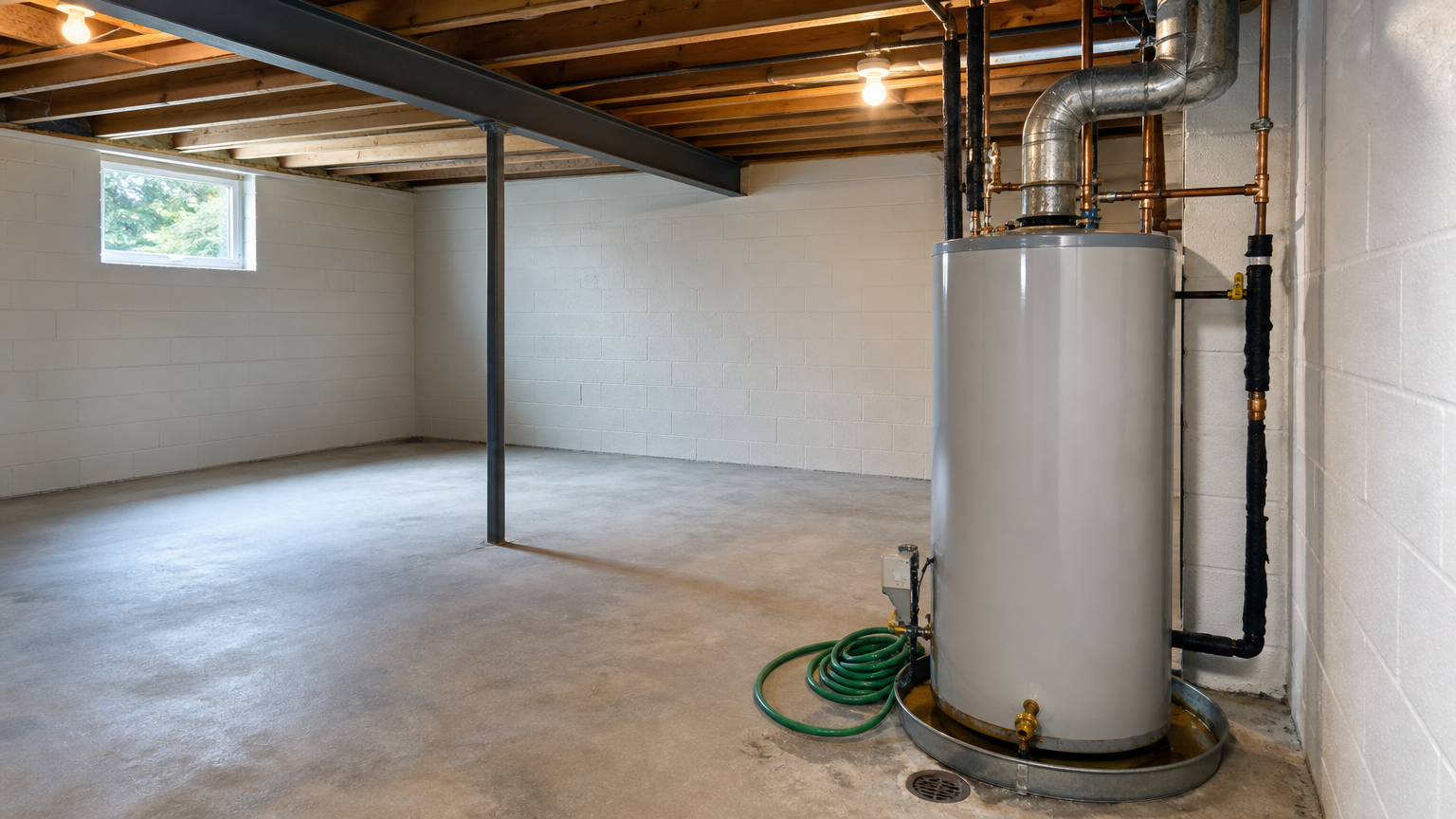
**Gas.** On a gas tank, the control is the dial or knob on the box bolted to the front of the tank near the floor. Turn it to "off." There is also a shutoff handle on the gas pipe running to that box: when the handle sits crosswise to the pipe, it's closed. Turning the control off stops the burner from firing into a tank that may be emptying itself.
**Cold water in.** Follow the two pipes at the top of the tank. One will have a valve on it — a handle or a round knob — on the cold side. Close it. If that valve is seized or drips when you touch it, close the main water shutoff where the service line enters the house instead.
**Water on the floor.** Get it out of the way of anything that plugs in, and away from finished walls and stored boxes. Wet drywall and wet insulation are what turn a tank failure into a bigger bill.
**Drain the tank if the leak is slow and the floor is at risk.** There's a hose bib at the bottom. A garden hose to a floor drain or a sump pit will empty it, slowly, once you open a hot faucet upstairs to let air in.
Leave the gas off. Don't relight it "just to get one more shower."
Is it actually the tank?
Water at the base is not automatically a dead tank. Before you buy a new one, look at where the water starts:
A copper pipe running down the side of the tank to near the floor is the relief discharge line. If water is coming out of the end of that, the problem is pressure or temperature, not a rusted tank.
Fittings at the top can drip and run down the outside of the tank, pooling at the base and looking exactly like a bottom leak. Dry everything, put down paper towel, and check again in an hour.
Condensation on a cold morning, in an unheated basement, on a tank that just refilled, is real and goes away.
Rust-stained water seeping from under the jacket, steadily, with no other source above it, is the tank shell. That one is not repairable.
If it's a fitting, a valve or a thermostat, you're in repair territory — $200 – $800 — not replacement. If it's the shell, no one can weld it and you shouldn't let anyone try.
What a same-week 50-gallon gas replacement runs here
Most swap-outs land in $1,400 – $3,400. Repairs run $200 – $800. Moving to a tankless unit is a different job — new venting, usually a larger gas line, sometimes a condensate drain — and prices at $3,500 – $7,500.
What moves your number inside that range is rarely the tank. It's the venting, the gas line, the shutoff valves that crumble when someone touches them, the door the old tank has to fit through, and whether the job is in an open basement or a closet.
The permit part
Permits here come from your township or borough, not the county. Whether a straight water heater swap needs one depends on which municipality you're in, and the answer is not consistent across the two counties.
Whitemarsh Township, for example, states plainly that a permit is required to install, repair, replace or convert a gas or plumbing system, and lists adding or replacing plumbing fixtures — water softeners and water heaters specifically — among the work that needs one. Warrington Township's FAQ, on the other hand, says simple replacement work without structural changes can be done without a permit, using kitchen cabinets and siding as its examples. Two townships, two starting points. Ask yours about your job rather than assuming.
Fees are set locally too. Warrington's ordinance amends the plumbing code so that fees for all plumbing work follow the fee schedule adopted by its Board of Supervisors — which is why the same job costs a different amount to permit a township away.
Two practical notes. Doylestown Borough says the most common cause of delay on electrical and mechanical permits is applicants not supplying required items, equipment specifications among them — so get the spec sheet for the unit being installed and hand it over with the application. And some offices have moved online: Abington Township's fire and code services department has gone to a fully digital permitting process as of July 1, 2025.
We have a separate page on permits for this exact job; this section is the short version.
Older houses, tighter basements
Bucks County's housing stock is older than the newer developments suggest: roughly 9.8% predates 1940, another 19.8% went up in the 1940s and 1950s, and the largest single group — 29.1% — was built between 1960 and 1979. In those houses the water heater is often in a low basement with a masonry chimney, narrow stairs and old valves. That's where the extra hours go.
Montgomery County skews differently. Only 53.7% of its homes are detached single-family, and around 30% sit in buildings of ten or more units. If you're in a condo, a townhouse or an apartment building, the tank may be in a closet, the venting may be shared, and someone other than you may have to approve the work and the access.
Pennsylvania moved to the 2021 International Code family and the 2020 National Electrical Code on 1 January 2026, so work permitted now is reviewed under those editions rather than the older ones your last replacement fell under.
What you can check yourself before anyone comes out
The data plate on the side of the tank: capacity, model, and the date it was built. A tank past its teens is usually replaced, not repaired.
Whether the shutoff on the cold line actually closes. If it doesn't, say so when you call — that changes the first thirty minutes of the visit.
Whether there's a floor drain nearby, and whether it drains.
How the old tank leaves the house. Measure the doorway if there's any doubt.
Your carbon monoxide alarms. The utility's own advice includes testing carbon monoxide and smoke alarms, and keeping snow and ice clear of water heater, furnace and fireplace vents so carbon monoxide can't back up.
If you're replacing because of rusty water rather than a leak, and you're an Aqua Pennsylvania customer: the company has replaced close to 3,000 lead and galvanized service lines since 2024, roughly 470 of them in Bucks County, at no direct cost to the customer. Check their service line inventory before paying anyone to investigate your line.
Hiring for a same-week job
Pennsylvania requires anyone doing more than a set annual amount of home improvement work to register with the Attorney General. Registration numbers start with "PA" and are searchable on a public register, and a contract above the state's threshold has to give you three days to cancel. Those are things you can check yourself, in a few minutes, before anyone starts cutting pipe.
We introduce you to independent local contractors. Nobody here is screened or endorsed by us, and the checks above are yours to make.
The old tank leaves with the installer in most cases. Montgomery County's own information page for water heaters points residents to its metal and scrap guidance — worth knowing if you end up handling disposal yourself.
Don't guess what your project will cost.
Answer a few questions and see a range for your house before anyone calls you.
What affects the cost?
The things the estimate actually asks about — these change the number, not the wording.
Tank or everything around it
A failed shell is a straight swap. Crumbling shutoff valves, corroded unions and old flex connectors add labor that has nothing to do with the tank you picked.
Venting and gas connection
A tank venting into an old masonry chimney, or a gas line that has to be adjusted or resupported, costs more than a clean reconnect in an open basement.
Getting it in and out
Narrow basement stairs, a closet installation, or a doorway the old tank barely cleared all add time. Measure the route before anyone quotes you.
Permit and inspection
Permits come from your township or borough, and fees are set locally. Missing paperwork, like the equipment spec sheet, is a common cause of delay.
Same-week timing
Sourcing a unit today and fitting the work around a schedule generally costs more than booking two weeks out.
Common questions
Water is under the tank but I can't tell where it's coming from. Do I have to replace it?
Not necessarily. Dry the whole tank and the floor, lay down paper towel, and check in an hour. Water from the discharge pipe running down the side means a pressure or temperature problem. Water from a top fitting running down the jacket looks like a bottom leak and isn't one. Rust-colored seepage from under the jacket with nothing above it is the tank shell, and that's a replacement.
Should I shut the gas or the water off first?
Gas. Turning the gas control off stops the burner from firing on a tank that may be losing water. Then close the cold water valve at the top of the tank. If you smell gas at any point, skip all of it, leave the house, and call from outside.
Do I need a permit to swap a 50-gallon gas heater?
It depends on your municipality, which is an unsatisfying answer but the honest one. Whitemarsh Township lists replacing water heaters among the work requiring a permit; Warrington Township's FAQ says simple replacements without structural changes don't need one. Every Bucks municipality enforces the state construction code locally, so the office to ask is your own township or borough. We have a longer page on this.
Can I keep using it for a few days until the new one is installed?
If the tank shell is leaking, no — it will get worse without warning, and a gas burner under a failing tank is not something to leave running. If the drip is a fitting or the discharge line and the floor is protected, you sometimes can, but that's a call for whoever looks at it.
Is a same-week replacement more expensive than one I schedule?
Often somewhat, because it's fitted around other work and the unit has to be sourced that day rather than ordered. The bigger variable is usually the condition of what the new tank connects to — old gas shutoffs, corroded water valves, venting that no longer passes — not the calendar.
Should I put in a tankless unit instead while everything is apart?
Only if you were already considering it. It's a different job, typically involving new venting and gas supply work, priced at {{cost_tankless}} rather than {{cost_water_heater}}. In a week where your basement is wet, replacing like for like is usually the faster path.
Related guides
All articles →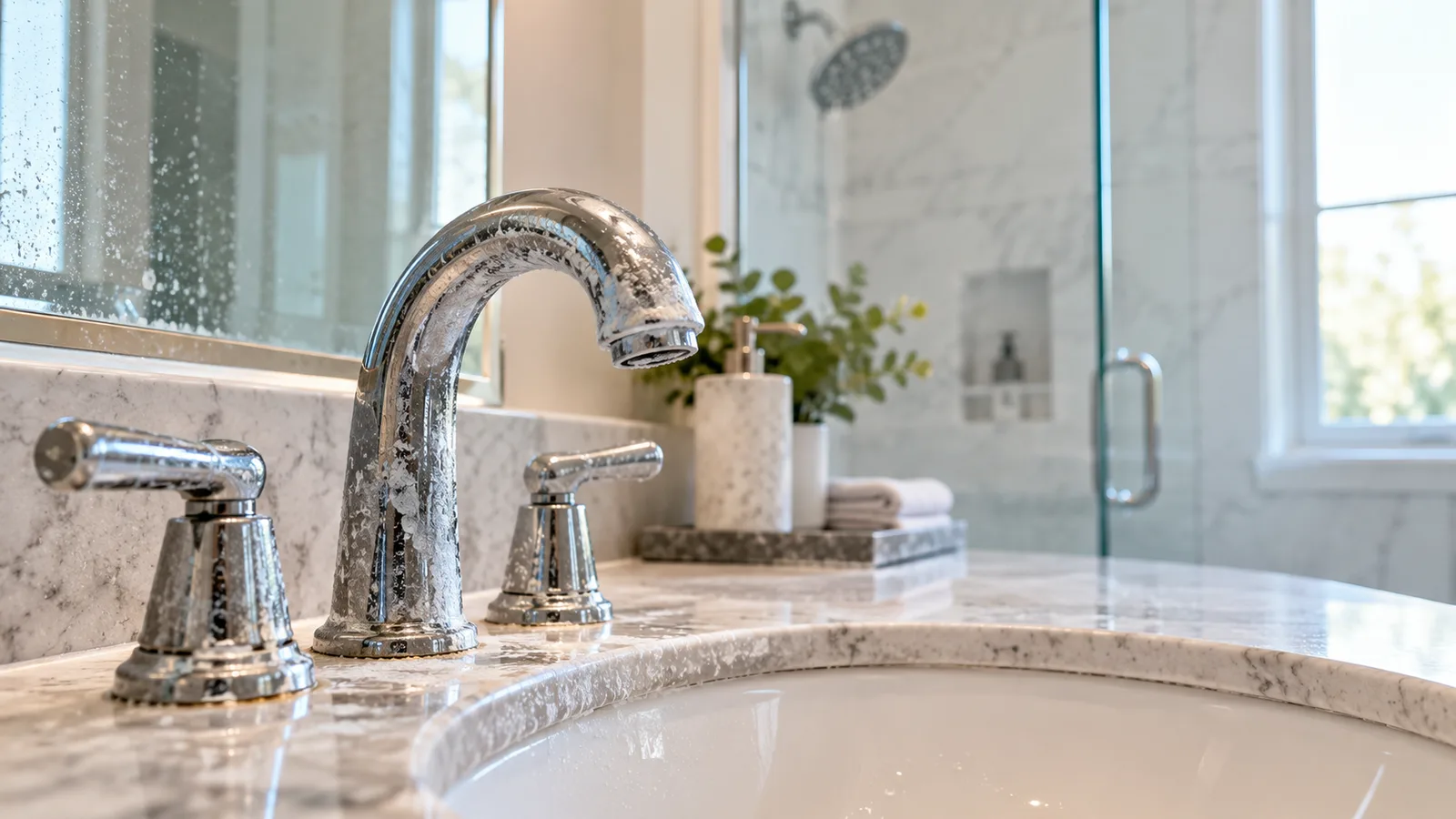 Article
How hard is the water here, really?
Horsham averages about 16 grains per gallon — squarely 'very hard'. Buckingham runs 7 to 10. What those numbers do to a water heater, and what is worth doing about it.
 Article
Levittown was built on slabs, and it still shows
17,311 homes built 1952–1958 across four municipalities, all slab-on-grade. Why that one construction decision still shapes what work costs and how it is done.
 Article
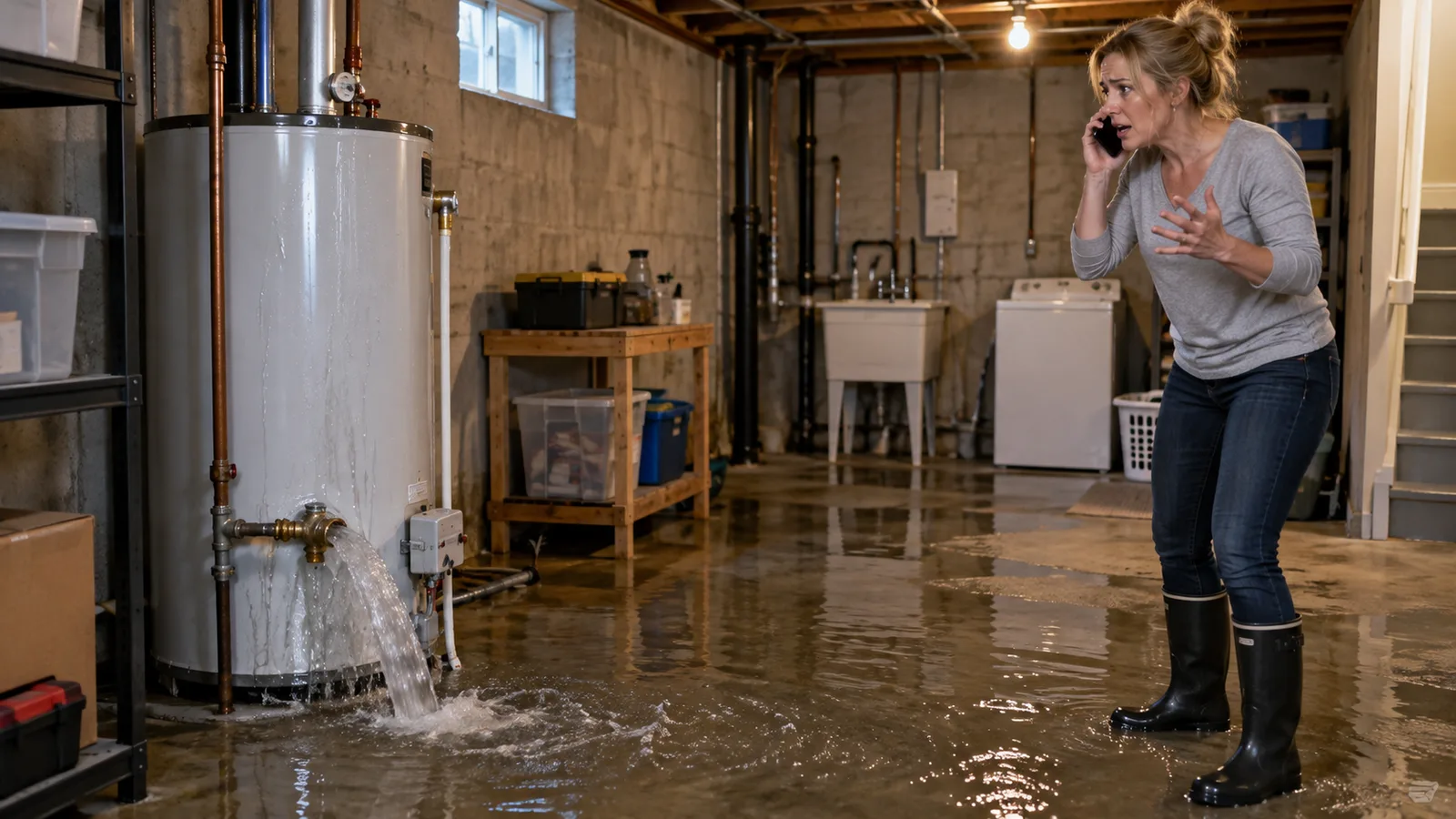
Do you need a permit to replace a water heater here?
Short answer: almost always yes, and it is your township that issues it, not the county. What the regulation actually says, and the three-day rule for emergencies.