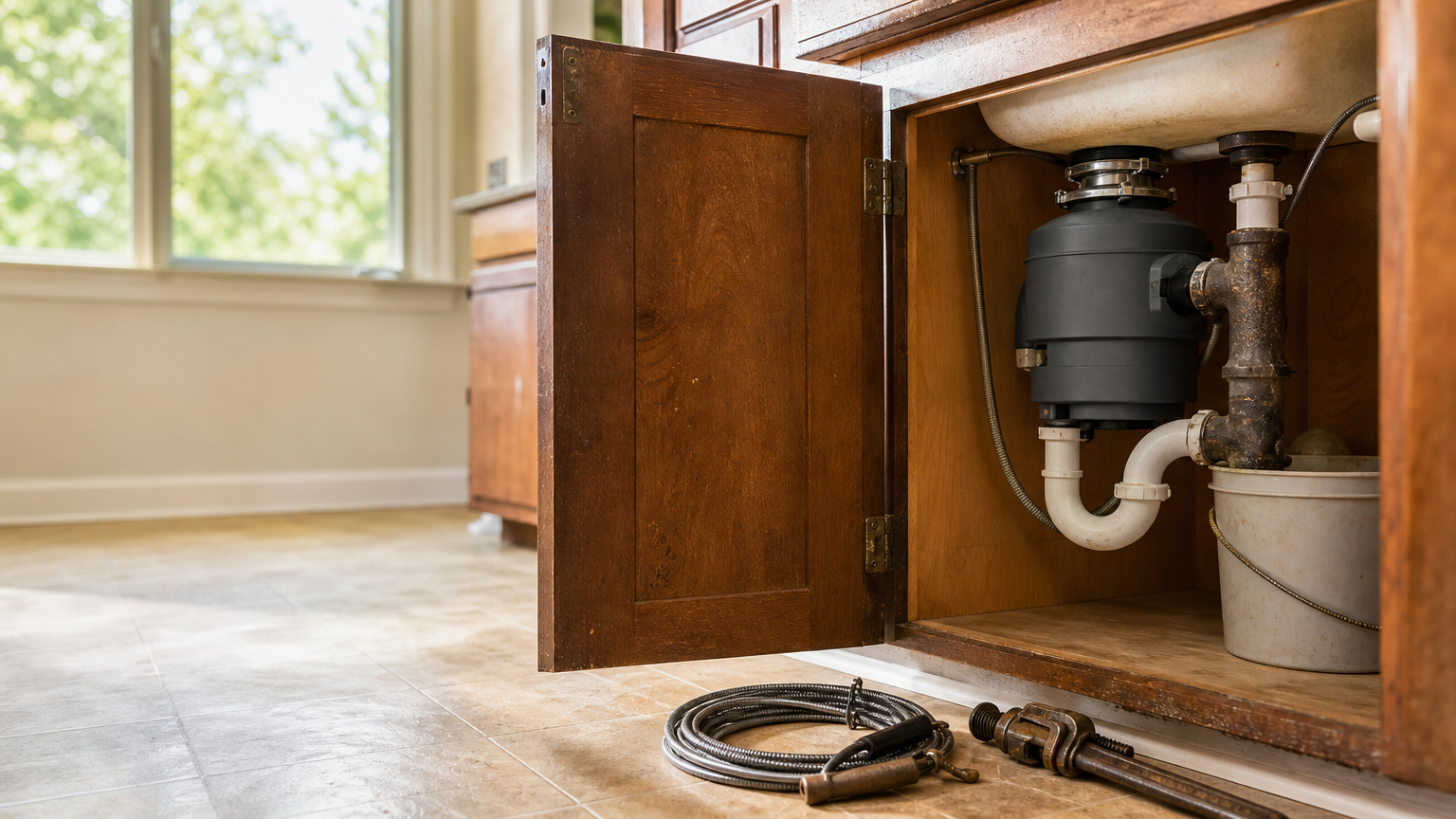
Your kitchen sink has backed up for a week straight. Here's what's really going on.
A sink that drains after you plunge it and backs up again two days later almost never has a clog in the trap — it has a pipe whose walls have narrowed, usually with cooking grease, scale or roots, so every wash cycle refills it. Most single-kitchen blockages in this area are cleared in one visit for $100 – $400, and the reason the number moves is how far down the line the plumber has to reach and whether there's a cleanout to reach it through. The first thing to work out, before you call anyone, is whether the problem stops at the kitchen or involves the whole house.
- Independent local contractors
- A cost range in about 60 seconds
- Free — contractors pay us, not you
- Offer times you're home, if you like
Get your estimate
A few questions about the job, a range in about a minute. No sign-up.
How much of the house is affected?
Takes about 60 seconds · No obligation · A range, not a quote
Plumbing costs
at a glance
| Kind of job | Typical range |
|---|---|
| Clearing a blocked drain | $100 – $400 |
| Clearing the main line | $200 – $700 |
| Hydro jetting a blocked line | $600 – $1,600 |
| Sewer line repair | $2,500 – $8,000 |
| Sewer line replacement | $5,000 – $15,000 |
| Fixture work | $300 – $1,200 |
| Leak repair | $300 – $2,500 |
| Your project, answered in a minute | Get a range → |
Ranges come from the same calculator the estimate uses, so this table and your estimate can never disagree. They are planning figures for this region, not a quote — a contractor prices the job after seeing it. Estimated range only. Final pricing requires contractor evaluation.
How much does plumbing cost?
First test: is it the kitchen, or the whole house?
Run the bathroom sink and flush a toilet while you watch the kitchen sink and the lowest drain in the basement. Montgomery Township Municipal Sewer Authority's own troubleshooting page makes this the first check: if drains gurgle as they back up, that points at the main line rather than one fixture. Their page describes the test as running fixtures and watching whether water rises somewhere else.
Only the kitchen sink is affected → the branch line serving that sink, usually within the house.
Kitchen plus laundry tub, floor drain, or a downstairs toilet → the house drain or the lateral out to the street.
That distinction changes the work and the price. A branch line is $100 – $400. The main line is $200 – $700.
Why grease makes a clog that keeps coming back
Montgomery County's own disposal guidance puts it plainly: cooking oil and grease stick to pipes when poured down the drain and can cause backups, and flushing with hot water does not always clear it. Hot water and detergent move the grease a few feet down the pipe, where it cools and sticks again. That is exactly the pattern of a sink that works Monday and fails Wednesday.
A cable bores a hole through that build-up. Water runs, everyone relaxes, and the hole closes over. Stripping the pipe wall back to bare metal is a different job — that's what hydro jetting is for, at $600 – $1,600 — and it is usually worth it only when the line has repeatedly re-clogged in the same spot and a camera has shown the pipe is sound enough to take it.
Older houses here have two extra problems
Bucks County's housing stock is older than the newer subdivisions suggest: roughly a tenth predates 1940, another fifth went up in the 1940s and 1950s, and the largest single group was built between 1960 and 1979. Kitchen drains of that age are often cast iron or galvanized steel, and the inside diameter is smaller than the day it was installed.
The second problem is access. The sewer authority notes that a home built before 1978 may not have a sewer line cleanout at all. No cleanout means the plumber pulls a toilet or opens the line somewhere, which adds an hour before any cabling starts.
Outside, the same age shows up as roots. Mature trees on an older property can send roots into the underground pipe and cause the backup, which is the case the authority describes.
Who owns the pipe that's blocked
In Montgomery Township, the authority is direct about it: in most cases the property owner is responsible for maintaining, repairing and replacing the entire service line from the building to the connection at the public sewer main. Blockages, that same authority notes, can happen either in its main or in the private line the owner maintains — so if several houses on your block are having trouble at once, report it before you pay for a camera.
In Philadelphia the rule is the same in effect: the city lists maintaining and repairing the sanitary and storm sewer lateral connecting your house to the sewer main as a customer responsibility.
Philadelphia row homes also have two parts most suburban homes don't. The Water Department's responsibility list includes a curb trap — a J-pipe between the house drain and the lateral — and a fresh air inlet vent pipe. The curb trap is a classic place for a kitchen-grease blockage to settle, and it is on the homeowner's side of the line. If the city finds lines that aren't fully operational, it serves a notice of defect with a period to repair.
On septic? A kitchen backup may not be a clog at all
Much of upper Bucks and parts of Montgomery County are on on-lot systems. The state lists backup of sewage into laundry tubs or other fixtures among the signs of a system in trouble, and recommends pumping the tank every three years or so depending on tank and household size. If your last pump-out is a hazy memory, get that date before anyone runs a cable.
The same state guidance says the bacteria doing the work in the tank can be impaired by substances put into the system, listing oils and grease and harsh drain cleaners among them, and advises using the garbage disposal sparingly because those wastes add to the burden.
About the bottle under the sink
If you've already poured chemical drain opener down a line that isn't moving, tell whoever opens the trap, because it's still sitting there. Leftovers don't go in the trash: Bucks County accepts caustics such as household lye and oven cleaner at its household hazardous waste collection events, which are free drop-off with no registration.
Permits, and when you actually need one
Clearing a stoppage is not permit work in Philadelphia — the city's plumbing permit page specifically exempts stopping leaks and clearing stoppages, while installation, alteration, replacement and repair do need a permit. If the fix turns into pipe, the city allows some of that work through an EZ permit with no plans, including a new or replacement house drain serving a single building, and sealing a lateral.
In Bucks and Montgomery counties there is no single permit desk. The state code sets the floor but over 90% of Pennsylvania's 2,562 municipalities administer and enforce it themselves, and every municipality in Bucks County has opted in, so the form, the fee and the inspection slot come from your own township or borough.
Where a line has to be dug up or relined, you're into $2,500 – $8,000, and a full replacement is $5,000 – $15,000. Replacing a failed disposal, trap arm or basket strainer as part of the same visit sits at $300 – $1,200.
Selling, or just bought, in Lower Bucks?
Some townships require the lateral to be looked at when the property changes hands. Falls Township requires a video inspection of the sanitary sewer lateral from the residence to the connection, prior to transfer, and its ordinance says the purpose includes finding holes or damage, checking cleanout caps, and identifying clay or older laterals. If the line is found defective, the ordinance puts replacement or realignment at the owner's expense, performed by a master plumber or utility contractor. Check your own township's code before you assume you're exempt.
What a sensible visit looks like
Cable the line through the nearest cleanout, correct cutter head for the pipe size.
If it clears and has cleared before, run a camera. The authority describes the same order: auger first, then a fiber optic camera to work out what's going on.
Get the recording and the footage distance, in feet from the access point. That number is what tells you whether the next step is jetting, a spot repair or nothing.
Ask what was pulled out. Grease, roots and a broken pipe are three different futures.
Before signing anything, check the contractor's Pennsylvania home improvement registration on the Attorney General's public register, and note that a contract above the state's threshold gives you three days to cancel. In Philadelphia, plumbing work also requires the contractor to hold the city's own trade licence, and the city publishes a lookup. HomeProjectMatch introduces you to independent local contractors; we don't screen them, so those two checks are yours to make.
Don't guess what your project will cost.
Answer a few questions and see a range for your house before anyone calls you.
What affects the cost?
The things the estimate actually asks about — these change the number, not the wording.
How far down the blockage sits
A trap arm under the sink is a short job. A blockage out past the foundation means longer cable, more time, and often a camera afterward to see what caused it.
Whether the house has a cleanout
A home built before 1978 may not have a sewer line cleanout, and the sewer authority says so plainly. Without one, the plumber has to open the line somewhere else first.
Cabling versus jetting
A cable punches through; jetting scours the pipe wall. Jetting costs more and only makes sense once a camera has shown the pipe can take it.
What the pipe is made of
Cast iron and galvanized drains in older Bucks and Montgomery County housing have narrowed from the inside. Clay laterals outside are the ones that take roots — the ones Falls Township's ordinance singles out for identification.
Whether it turns into pipe work
Clearing a stoppage needs no permit in Philadelphia, but replacing a house drain or sealing a lateral does, and each township here runs its own permit and inspection process.
Common questions
I snaked it myself and it drained fine. Why did it come back in two days?
Because a cable makes a channel through a soft blockage rather than removing it. If the pipe wall is coated in grease, the channel closes as soon as the coating cools around it. Montgomery County's guidance notes that grease sticks to pipes and hot water won't always clear it. A repeat clog in the same spot is the reason to camera the line rather than cable it a third time.
How do I know if the blockage is mine or the sewer authority's?
Check whether more than one fixture is affected, then report it. The authority's own material says blockages can be in its main line or in the private service line the owner maintains — and in Montgomery Township the owner is responsible for the whole lateral from the building to the main. Philadelphia lists the lateral as the customer's too. Reporting it first costs nothing and occasionally saves the whole visit.
Do I need a permit to have a drain cleared?
No. In Philadelphia the city explicitly exempts clearing stoppages from the plumbing permit requirement. If the visit turns into replacing pipe, that's permit work — from L&I in the city, from your township or borough everywhere else, since municipalities here administer the code themselves and the paperwork differs between them.
We're on septic and the kitchen sink is backing up. Is it the drain or the tank?
It depends, and the order matters. The state lists sewage backing up into laundry tubs or other fixtures as a sign of an on-lot system in trouble, and recommends pumping roughly every three years. Find out when the tank was last pumped first — cabling a house drain that's backing up because the tank is full just moves the problem.
Is a camera inspection worth paying for, or is it a sales tactic?
Worth it the second time you have the same clog, not usually the first. The sewer authority describes the normal sequence as augering first and using a camera if that doesn't solve it. Ask for the footage and the distance reading — that's the part you keep.
Should I pour a drain opener down it while I wait?
If it hasn't moved in a week, it probably won't help, and the liquid stays in the trap for whoever opens it. On septic, the state lists harsh drain cleaners among substances that can impair the bacteria in the tank. Leftover caustics can go to a Bucks County household hazardous waste event, which is free and needs no registration.
Related guides
All articles → Article
Gas water heater leaking from the bottom: what to shut off first, and what a same-week 50-gallon replacement runs here
Water pooling under a gas water heater in Bucks or Montgomery County? What to shut off, in what order, and what a same-week 50-gallon swap costs.
 Article
How hard is the water here, really?
Horsham averages about 16 grains per gallon — squarely 'very hard'. Buckingham runs 7 to 10. What those numbers do to a water heater, and what is worth doing about it.
 Article
Levittown was built on slabs, and it still shows
17,311 homes built 1952–1958 across four municipalities, all slab-on-grade. Why that one construction decision still shapes what work costs and how it is done.