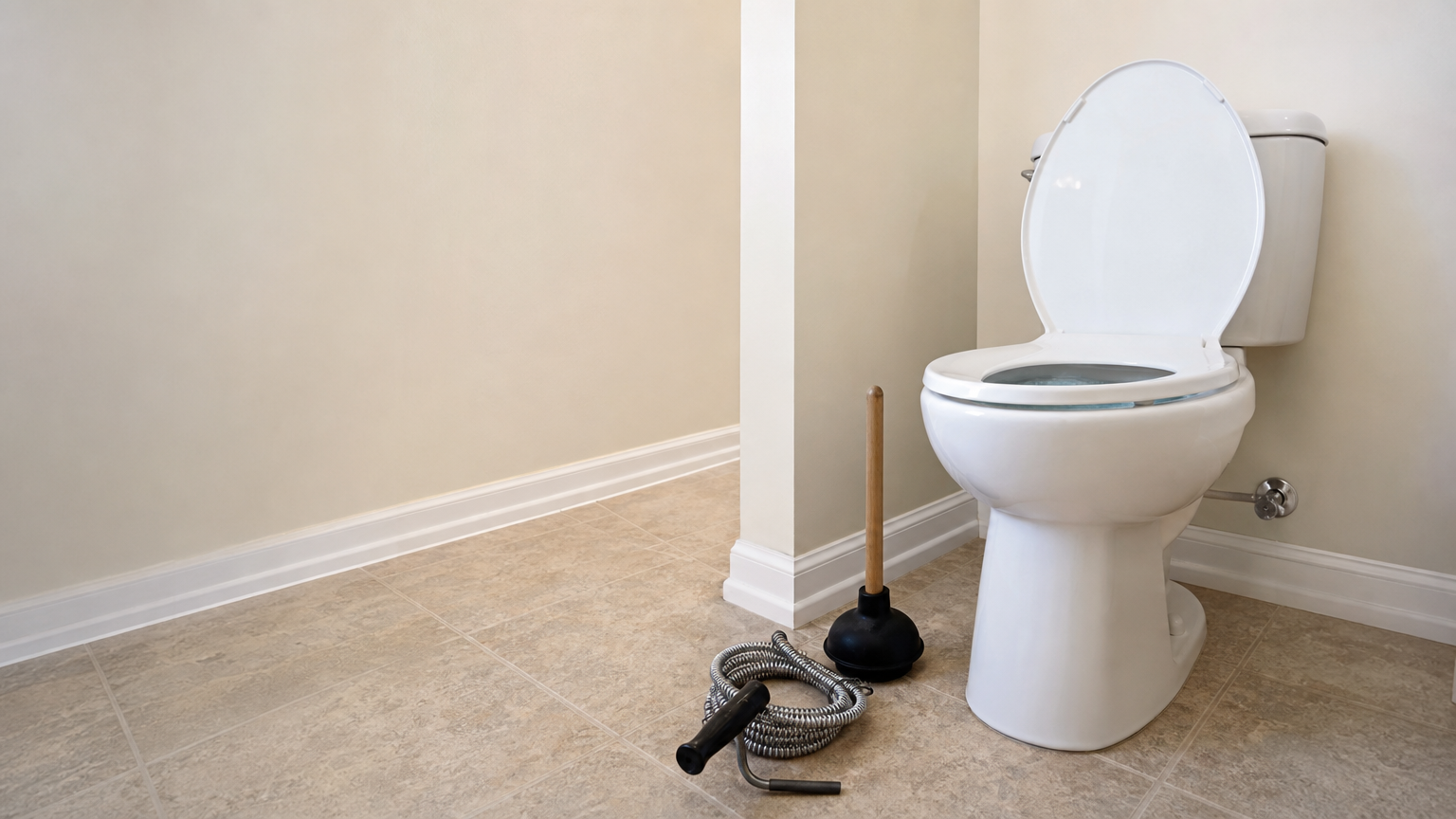
Toilet Clogged and the Plunger Is Not Working
If one toilet is clogged and nothing else is backing up, the next step is usually a toilet auger or a fixture-level drain call, not sewer excavation. Around Bucks and Montgomery County, a typical urgent toilet or drain-clearing visit is usually shown as $100 – $400, while a suspected main-line backup moves the estimate toward $100 – $700 or $600 – $1,600.
- Independent local contractors
- A cost range in about 60 seconds
- Free — contractors pay us, not you
- Offer times you're home, if you like
Get your estimate
A few questions about the job, a range in about a minute. No sign-up.
How much of the house is affected?
Takes about 60 seconds · No obligation · A range, not a quote
Plumbing costs
at a glance
| Kind of job | Typical range |
|---|---|
| Clearing a blocked drain | $100 – $400 |
| Clearing the main line | $100 – $700 |
| Hydro jetting a blocked line | $600 – $1,600 |
| Drain or sewer line | $200 – $8,000 |
| Sewer line repair | $2,500 – $8,000 |
| Sewer line replacement | $5,000 – $15,000 |
| Fixture work | $300 – $1,200 |
| Your project, answered in a minute | Get a range → |
Ranges come from the same calculator the estimate uses, so this table and your estimate can never disagree. They are planning figures for this region, not a quote — a contractor prices the job after seeing it. Estimated range only. Final pricing requires contractor evaluation.
How much does plumbing cost?
First: stop making the backup worse
If the bowl is already high, do not flush again. Shut the small supply valve behind the toilet if water keeps entering the tank, lift the tank lid, and keep towels nearby.
A municipal drain guide gives the simple reason: repeated flushing a slow toilet can overflow the bowl and damage property.
Skip chemical drain opener if you may call for help. It can leave harsh water in the bowl and make the next step messier.
What to try after the plunger
Try these in order:
Wait a few minutes if the bowl is full. Some paper clogs soften.
Use a toilet auger, not a thin sink snake. A toilet auger is shaped to pass through the toilet trap with less risk of scratching the bowl.
If the auger hits something hard and will not pass, stop. Toys, caps, wipes, and hygiene products can lodge in the trap.
If the toilet clears but clogs again the same day, treat it as a drain problem, not a one-time toilet problem.
A plunger can work when the clog is near the drain opening or toilet bowl. When the blockage is farther down the drain line, a contractor may need to locate and clear it with longer equipment.
When it is probably not just the toilet
A single clogged toilet usually points to the toilet trap or the short branch serving that fixture.
It may be a branch line or main-line problem when you see any of these:
The tub or shower gurgles when you flush.
A nearby sink drains slowly at the same time.
More than one bathroom is affected.
Water or sewage comes up from a tub, shower, laundry standpipe, or floor drain.
The same clog returns after it was cleared.
You notice wet areas or sewer odor in the yard.
Montgomery Township Municipal Sewer Authority lists sewage backing into sinks, tubs, showers, or floor drains, multiple slow drains, gurgling sounds, recurring backups, and wet areas or unusual yard odors as sewer-problem warning signs.
Check the cleanout if you can do it safely
If you know where the sewer cleanout is, look before you run more water.
A cleanout is often a capped pipe in the basement, crawl space, garage, front yard, side yard, or near the foundation. Do not remove a cap if sewage is under pressure or the area is unsafe.
A municipal drain guide describes a useful rule of thumb: if the cleanout near the house has no water in it, the blockage is probably inside the house plumbing; if water is visible there, the blockage is more likely between the house and the main sewer line.
That does not tell you who pays. It just helps you describe the problem when you request help.
Bucks and Montgomery County: lateral versus main
The expensive question is whether the clog is in your fixture, a branch drain, your private sewer lateral, or the public sewer main.
In Pennsylvania American Water wastewater areas, the utility says many blockages happen between the building and the utility sewer main, where the property owner is responsible for correcting the problem. The same page says each property connects through a customer-owned sewer lateral, and that the lateral and internal plumbing are the customer’s responsibility.
In Montgomery Township Municipal Sewer Authority’s service area, the authority says the sewer main is the large pipe in the public right-of-way, and that the authority owns, operates, and maintains that main. It also says the smaller pipe from the building to the public sewer main is the sewer lateral or service line, and that the property owner is usually responsible for maintaining, repairing, and replacing the whole service line.
For Lower Bucks County Joint Municipal Authority customers, the authority’s forms page lists sewer-connection documents, including a sanitary sewer lateral replacement permit and lateral replacement guidelines. That is a sign to ask about authority paperwork before any lateral replacement or excavation starts.
What an emergency call usually runs
Use these rough buckets:
One clogged toilet, no other fixtures affected: $100 – $400
Toilet plus tub, shower, floor drain, or more than one slow drain: $100 – $700
Main line keeps clogging, roots or heavy buildup suspected: $600 – $1,600
Camera shows a broken or collapsed section: $2,500 – $8,000
The private lateral has failed and needs full replacement: $5,000 – $15,000
Emergency timing usually raises the bill because the visit may include after-hours dispatch, travel time, immediate setup, and a higher chance of cleanup. If you can safely stop using water and wait for normal hours, ask for both options.
What to tell the contractor
Before you request an introduction to independent local contractors, write down:
Which toilet is clogged.
Whether any tub, shower, sink, laundry drain, or floor drain is affected.
Whether sewage is backing up or it is only slow draining.
Whether this has happened before.
Where the cleanout is, if you know.
Whether the home is on public sewer or septic.
Whether the work area is finished, tight, or easy to reach.
Photos help, but do not send anyone into sewage or standing wastewater.
When it becomes urgent
Treat it as urgent if sewage is coming up into a tub, shower, or floor drain; if the only working toilet in the house is unusable; if the bowl will not stop filling; or if wastewater is reaching finished flooring.
EPA notes that sanitary sewer overflows can contain raw sewage and that flooded areas need cleaning and disinfection to reduce disease risk. That is why a main-line backup is different from an annoying but contained toilet clog.
A Philadelphia note
If the same problem is at a Philadelphia property and the repair turns into a private sewer-line issue, the city’s Homeowner’s Emergency Loan Program may matter. Philadelphia says the program offers zero-interest loans for water service line and sewer line repairs, and that customers often use it for lines connecting homes to city pipes.
Don't guess what your project will cost.
Answer a few questions and see a range for your house before anyone calls you.
What affects the cost?
The things the estimate actually asks about — these change the number, not the wording.
How many fixtures are affected
One clogged toilet is usually less involved than a tub, shower, laundry drain, or floor drain backing up at the same time.
Cleanout access
An easy outdoor or basement cleanout can reduce time; no visible cleanout can mean pulling the toilet or using longer access routes.
Timing
Nights, weekends, and same-day emergency windows usually cost more than scheduled drain clearing.
Tool needed
A toilet auger is simpler than main-line equipment, camera work, or hydro jetting.
Damage risk
Sewage in a tub, shower, or finished room can add cleanup urgency and may change the scope of the visit.
Common questions
Should I keep plunging if the toilet will not go down?
Stop if the bowl is rising or the plunger is not moving the clog after a few solid tries. More flushing can overflow the toilet. Try a toilet auger next, or request help if the water level is high.
How do I know if it is the main line?
It is more likely to be the main or lateral if more than one fixture is affected, if tubs or floor drains back up, if you hear gurgling, or if the same clog keeps returning.
Is a toilet auger worth trying?
Yes, if only that toilet is affected and you are comfortable using one. Stop if you hit a hard object, the cable will not move, or water starts backing up elsewhere.
What does an emergency clogged-toilet call cost here?
A basic urgent drain-clearing visit is usually estimated at {{cost_drain_clear}}. If the symptoms point to the main line, use {{cost_drain_main}}. If heavy buildup or roots require jetting, use {{cost_drain_jetting}}.
Who pays if the clog is outside the house?
It depends on the sewer authority and where the blockage is. In many service areas, the private sewer lateral between the house and the public main is the homeowner’s responsibility. Ask the contractor to identify the likely location before approving larger work.
Do I need a permit to clear a clog?
Usually not for simple drain clearing. If the work turns into sewer lateral replacement, excavation, or a connection repair, ask your municipality or sewer authority what paperwork is required before the work starts.
Related guides
All articles → Article
Dripping kitchen faucet: repair, replace, and why stuck shutoff valves change the quote
A dripping kitchen faucet may be repairable, but stuck shutoff valves can add labor before the faucet is touched.
 Article
Gas water heater leaking from the bottom: what to shut off first, and what a same-week 50-gallon replacement runs here
Water pooling under a gas water heater in Bucks or Montgomery County? What to shut off, in what order, and what a same-week 50-gallon swap costs.
 Article
How hard is the water here, really?
Horsham averages about 16 grains per gallon — squarely 'very hard'. Buckingham runs 7 to 10. What those numbers do to a water heater, and what is worth doing about it.