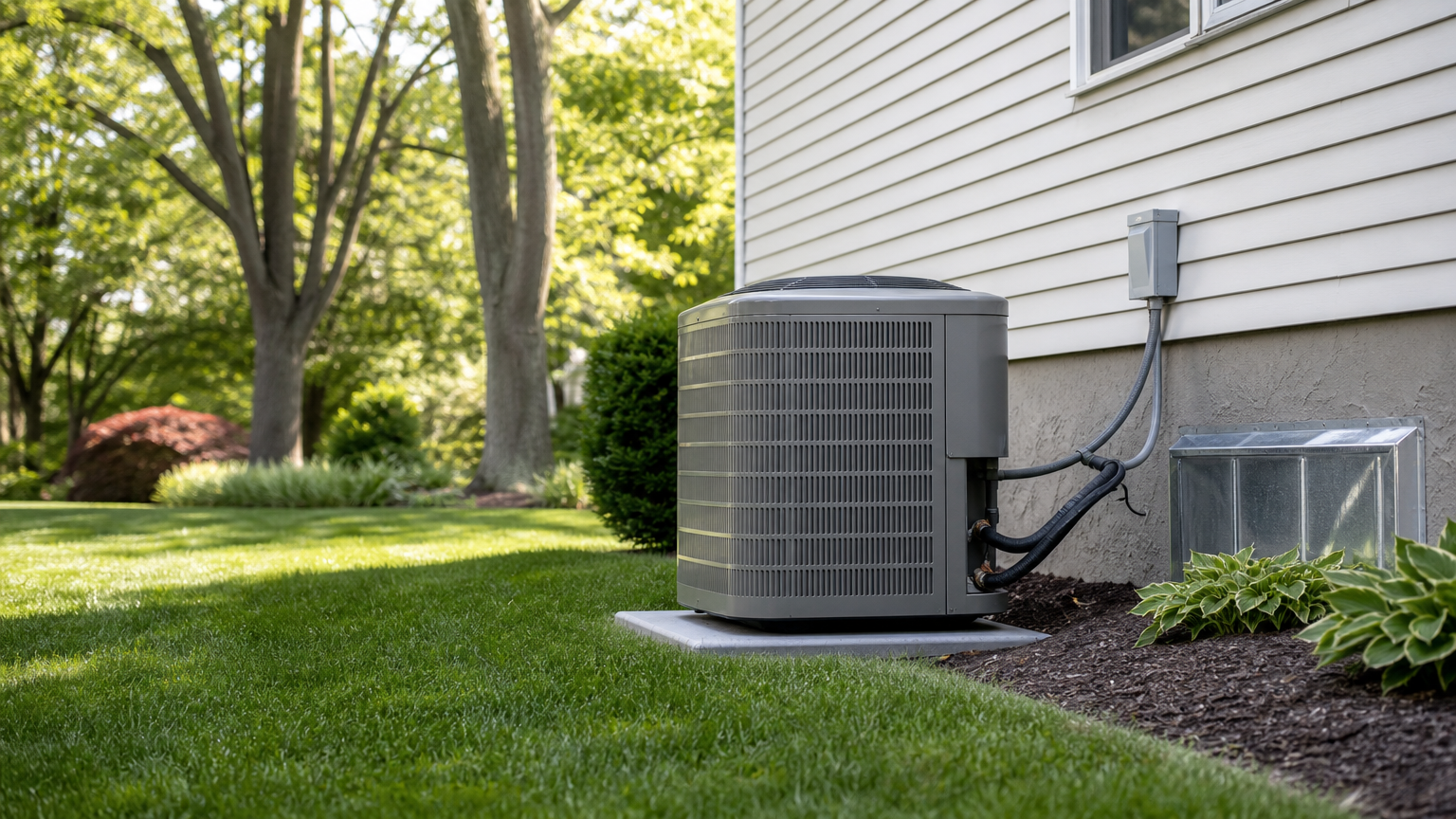
Air conditioning replacement in Plymouth Meeting: what permits and duct layouts mean for the quote
For a Plymouth Meeting central AC replacement, the starting point is usually $5,500 – $11,000, then the quote moves up or down based on duct condition, electrical work, outdoor unit placement and permit handling. Plymouth Township treats only a same make and model HVAC replacement as ordinary repair, so many replacement projects should be priced with permit paperwork in mind.
- Independent local contractors
- A cost range in about 60 seconds
- Free — contractors pay us, not you
- Offer times you're home, if you like
Get your estimate
A few questions about the job, a range in about a minute. No sign-up.
Does the house have ductwork?
Takes about 60 seconds · No obligation · A range, not a quote
Plymouth Meeting hvac costs
at a glance
| Kind of job | Typical range |
|---|---|
| AC replacement | $5,500 – $11,000 |
| Heat pump | $7,500 – $16,000 |
| Ductwork | $1,000 – $8,000 |
| Full system | $9,000 – $18,000 |
| Ductless mini-split | $3,500 – $9,000 |
| Furnace replacement | $4,500 – $9,500 |
| Repair | $200 – $1,500 |
| Your project, answered in a minute | Get a range → |
Ranges come from the same calculator the estimate uses, so this table and your estimate can never disagree. They are planning figures for this region, not a quote — a contractor prices the job after seeing it. Estimated range only. Final pricing requires contractor evaluation.
How much does hvac cost in Plymouth Meeting?
Why the permit question matters
In Plymouth Township, ordinary HVAC repair is not the same thing as a replacement that changes equipment. The township’s residential package lists “Replacement of HVAC equipment or systems with the same make & model only” under work that does not require a permit, and says other work needs the appropriate township permit.
That affects the quote because a replacement often includes more than setting a new outdoor unit. The proposal may need to include a mechanical permit application, job description, plans when requested, inspections, and time for review.
The township’s mechanical permit application asks for a description of work and says a copy of the contract is required at submittal. Ask each independent local contractor whether the permit is included, who submits it, and what inspections are expected.
Duct layout is often the bigger price swing
A straightforward AC replacement assumes the existing duct system can move enough air. That is not always true.
Common Plymouth Meeting quote differences come from:
Basement trunk lines with short branch runs: often the easiest layout to reuse.
Attic ducts serving the second floor: more labor if ducts are leaky, crushed, poorly insulated or hard to reach.
Partial duct systems: may need new returns, added supplies, or a ductless mini-split for a room the ducts do not serve well.
Older houses with small chases: can make new duct runs slower and more invasive.
Attached homes, condos or multifamily buildings: may limit condenser location, roof or wall penetrations, and where new ductwork can pass.
If the ductwork is in poor shape, compare $5,500 – $11,000 with $5,500 – $11,000 plus $1,000 – $8,000. If the ducts are missing or the upstairs is the main problem, compare central AC with $3,500 – $9,000 or $7,500 – $16,000.
What to check before you ask for quotes
Before meeting contractors, take a few notes:
Is the current outdoor unit staying in the same place?
Is the indoor coil above a furnace or in an attic air handler?
Are there rooms with weak airflow?
Are there return grilles on each floor, or only one central return?
Is the electrical panel full, old, or being changed as part of the project?
Is the home in a condo, HOA, historic district, or shared building?
These answers help separate a simple equipment change from a comfort project.
Outdoor unit location, noise and drainage
If the outdoor condenser stays on the same pad, the quote is usually simpler. If it moves, expect more discussion about line-set routing, electrical disconnect location, condensate handling, noise, and township rules.
Plymouth Township’s zoning performance standards include limits on sound reaching adjacent property. That does not mean every AC replacement has a noise problem, but it does mean placement near a lot line, bedroom window, or narrow side yard should be discussed before work starts.
If the work adds or relocates hard surface outside, ask whether stormwater review applies. Plymouth Township’s stormwater ordinance says impervious areas are measured for the total proposed development and that facilities over karst need evaluation to reduce adverse effects. For most basic AC swaps, this may not drive the job, but a larger pad, drainage change or grading work can change the permit conversation.
Electrical work after the state code update
Pennsylvania’s Uniform Construction Code update took effect on January 1, 2026. That matters when an AC replacement also includes panel work, a new circuit, a heat pump conversion, or service equipment replacement.
Do not assume the old disconnect, wire size or breaker can be reused. Ask whether the proposal includes any electrical permit work and whether the panel has capacity for the equipment being quoted.
How HomeProjectMatch fits in
HomeProjectMatch can show the cost range for an AC replacement and introduce you to independent local contractors. The most useful quote request says whether you want central AC only, AC plus furnace, a heat pump, duct repairs, or a ductless option for hard-to-cool rooms.
Don't guess what your project will cost.
Answer a few questions and see a range for your house before anyone calls you.
What affects the cost?
The things the estimate actually asks about — these change the number, not the wording.
Permit scope
A same make and model swap is simpler than a replacement that changes equipment, ductwork or wiring. Ask who files the mechanical permit and schedules inspections.
Duct condition
Good basement ducts can keep the job close to the AC replacement tier; attic ducts, leaky returns or partial duct systems can add ductwork.
Electrical changes
A new circuit, disconnect, panel space issue or heat pump conversion can add electrical labor and inspection steps.
Outdoor unit placement
Reusing the old pad is usually simpler. Moving the condenser can add line-set routing, pad work, noise review and drainage questions.
Timing and access
Emergency summer work, tight attic access, finished basements and condo approvals can all slow the job.
HVAC in Plymouth Meeting, PA
Plymouth Meeting sits on Cambrian carbonate bedrock rather than the schist under most of eastern Montgomery County, and Plymouth Township's stormwater ordinance singles it out, requiring designs over karst to evaluate measures that minimise the risk of adverse effects. Sinkholes have closed roads in the village more than once — Chemical Road in 2021 and Plymouth Road in 2024.
Montgomery County has noticeably more attached and multifamily housing than its neighbours — only 53.7% of homes are detached single-family, with around 30% in buildings of ten units or more. That changes what is possible in a renovation and who else has to agree to it.
Heating and cooling equipment here is sized against a 99% heating design temperature of 18°F and a 1% cooling design temperature of 90°F, putting the county in IECC Climate Zone 4A. That is well inside the range a modern cold-climate heat pump handles without leaning on backup heat.
Pennsylvania requires anyone doing more than $5,000 a year of home improvement work to register with the Attorney General. Registration numbers begin with "PA", carry minimum insurance requirements, and are searchable on a public register — and any contract for work over $500 must give you three days to cancel.
Building permits here are issued by your municipality rather than the county. Pennsylvania's Uniform Construction Code sets the floor, but over 90% of the state's 2,562 municipalities administer and enforce it themselves — so fees, forms and inspection scheduling differ from one township to the next.
Pennsylvania moved to the 2021 International Code family and the 2020 National Electrical Code on 1 January 2026. Among the residential changes: a surge-protective device is now required at the service panel, including when existing service equipment is replaced.
Sources: ecode360.com · cdn.dvrpc.org · energystar.gov · hicsearch.attorneygeneral.gov · pa.gov · codeadministrators.com
Common questions from Plymouth Meeting homeowners
Do I need a permit to replace central AC in Plymouth Meeting?
It depends on the municipality and the scope. Plymouth Township lists same make and model HVAC replacement as ordinary repair, but says work not listed requires the appropriate permit. If the equipment is changing, ask the contractor to explain the permit plan.
Why did one AC quote include ductwork and another did not?
One contractor may be pricing only the equipment swap, while another is pricing airflow fixes. Leaky ducts, undersized returns, crushed attic runs, and rooms with weak airflow can all move the job from {{cost_ac_replacement}} toward {{cost_ac_replacement}} plus {{cost_ductwork}}.
Should I replace AC with a heat pump instead?
Sometimes. A heat pump can cool like central AC and also provide heat. The right choice depends on your current furnace or boiler, duct condition, electrical panel capacity, comfort goals, and whether you want to reduce use of the current heating fuel.
Can I put the new outdoor unit in a different spot?
Usually possible, but not always simple. Moving the unit can add refrigerant line routing, electrical work, pad work, noise considerations, and possible zoning or historic review if the equipment is visible from a public way.
What should be included in an AC replacement quote?
Ask for the outdoor unit, indoor coil or air handler work, refrigerant line work, thermostat changes, duct modifications, electrical scope, permit handling, cleanup, and what happens if inspection requires changes.
Is a PA registration number the same as an endorsement?
No. The Pennsylvania Attorney General’s search page says registration is not an endorsement, recommendation or approval. Use the public register as one consumer check, not as a rating.