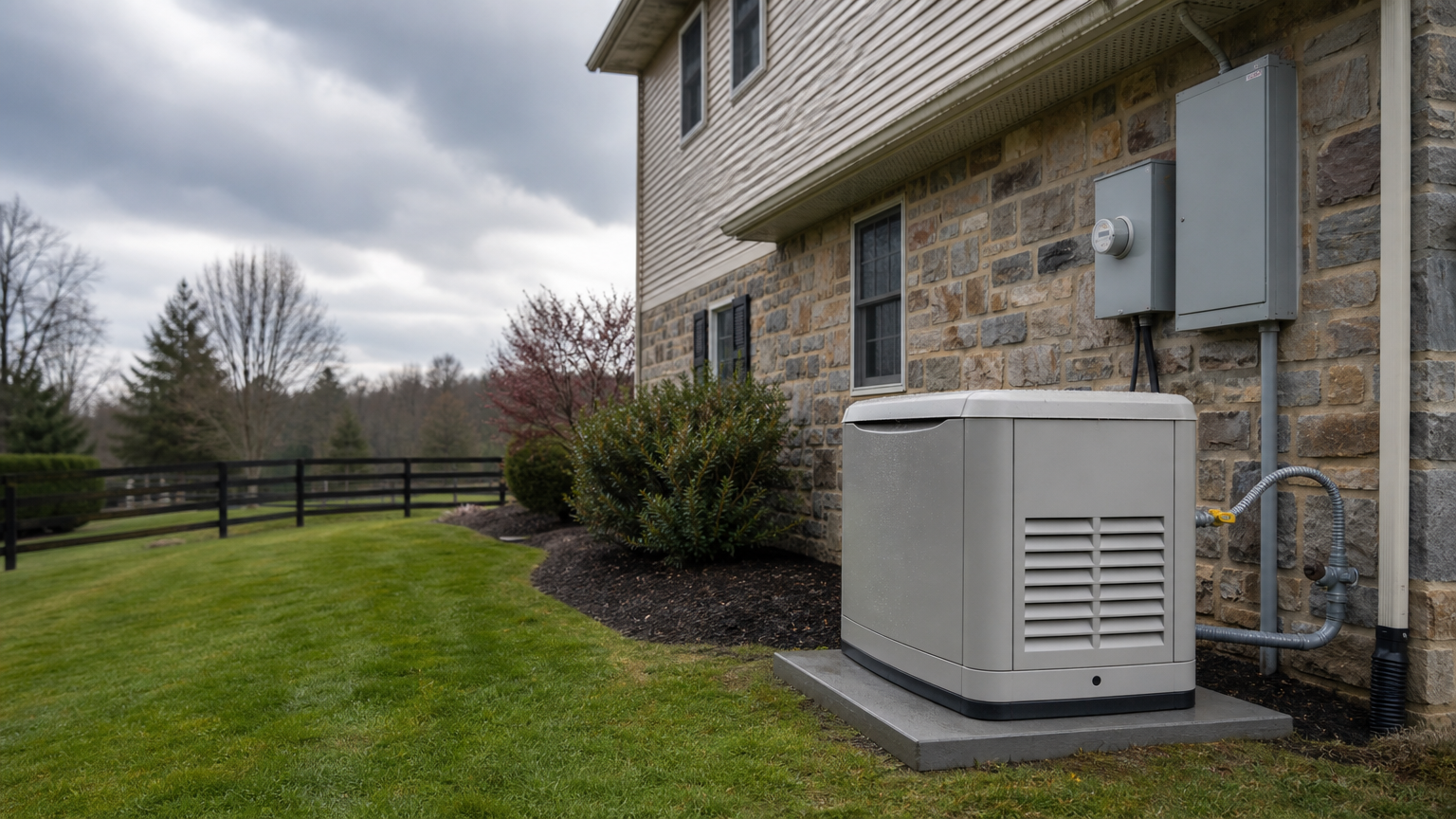
Standby generator installation in Fort Washington, PA
Most whole-home standby generator installations in Fort Washington land in the $13,500 – $19,500 range, and the spread comes down to three things: where the unit can legally sit, how far the gas and electrical runs have to travel, and what your service panel needs. If your property is in Upper Dublin Township, the permit and siting rules below are the ones that apply to you. Check which municipality your address falls in before you file anything — Fort Washington is a postal name, and Upper Dublin Township's own permit office uses a Fort Washington, PA 19034 mailing address.
- Independent local contractors
- A cost range in about 60 seconds
- Free — contractors pay us, not you
- Offer times you're home, if you like
Get your estimate
A few questions about the job, a range in about a minute. No sign-up.
Where would the generator go?
Takes about 60 seconds · No obligation · A range, not a quote
Fort Washington generators costs
at a glance
| Kind of job | Typical range |
|---|---|
| 22 kW | $13,500 – $19,500 |
| 18 kW | $12,500 – $17,500 |
| 26 kW | $16,000 – $24,000 |
| 14 kW | $10,500 – $15,000 |
| 10 kW | $8,500 – $12,000 |
| Your project, answered in a minute | Get a range → |
Ranges come from the same calculator the estimate uses, so this table and your estimate can never disagree. They are planning figures for this region, not a quote — a contractor prices the job after seeing it. Estimated range only. Final pricing requires contractor evaluation.
How much does generators cost in Fort Washington?
Why people here buy one
Outages in this area are not frequent, but they are long when they come. A one-hour thunderstorm on 20 June 2025 knocked out power to about 327,000 customers, and roughly 21,300 in Montgomery County were still dark that evening. The utility beat its benchmark for how often customers lose power and missed the one for how fast it restores them. Before that, an EF-2 tornado with peak winds estimated at 130 mph touched down here on 1 September 2021 and tracked about eight miles north-east through Upper Dublin and Maple Glen to Horsham, taking roofs off houses along the way.
That pattern — rare but multi-day — is the case for a permanently installed unit rather than something you wheel out of the garage.
Where the generator can go
This is the first thing to settle, because it drives the price more than the generator itself.
Upper Dublin's zoning code says accessory buildings, structures and uses may be erected or conducted in a side or rear yard, but not a front yard. They must sit no closer than 10 feet from the principal building, and no closer to any side or rear property line than the greater of 10 feet or any other setback that applies. In the B, C and NH Residential Districts, accessory buildings or structures may be set back as close as four feet to a side or rear line if they are of fire-resistant construction. They also may not encroach on any easement, right-of-way or sight distance triangle. Ask the zoning office in writing whether they treat a generator and its pad as an accessory structure at your address before you promise a spot to anyone.
Two practical consequences on a typical Fort Washington lot:
A front-of-house location is off the table under those rules, even if that is where the gas meter happens to be.
The pad is hard surface. The code counts the horizontal area of accessory buildings and structures as building coverage and impervious surface, so on a lot already close to its coverage limit, a pad is not a free addition.
Walk the side yard with a tape measure. Ten feet off the wall and ten feet off the property line eliminates a lot of narrow side yards immediately, which pushes the unit to the rear and lengthens both the gas line and the electrical run.
Gas supply
Natural gas is the usual fuel here when the street has it. Adding or converting gas service is a request to the gas utility, which takes an application to have natural gas installed at your location and asks for equipment information as part of it — that equipment information is where generator load gets declared.
What moves the number:
Distance from the meter to the generator, and whether the run crosses a driveway or patio.
Pipe size. A generator is a large intermittent load added on top of the furnace, water heater, range and dryer. If the existing line and meter cannot carry everything at once, something has to be upsized, and that can mean utility work at the meter rather than just contractor work in your yard.
Propane instead. If gas does not reach your street, propane is the fallback, and then tank size, tank placement and whether you own or lease the tank all change what the install and the running costs look like.
Ask any contractor to show you the gas load calculation, not just the sentence "your line is fine."
The electrical side, and what the utility is involved in
A standby generator is wired through a transfer switch that isolates the house from the incoming service before the generator picks up load. The install therefore touches your service equipment, and that is where older panels become the hidden cost.
Pennsylvania moved to the 2021 International Code family and the 2020 National Electrical Code on 1 January 2026. Among the residential changes, a surge-protective device is now required at the service panel, including when existing service equipment is replaced. If your panel is being swapped as part of the generator job, budget for that device as part of the work.
Two questions worth asking in the quote stage, because the answers differ by property and we are not going to guess at yours:
Does anything in this job require work at the electric meter or on the service drop, and who schedules that with the utility?
Is the panel being replaced, sub-fed, or left alone — and if replaced, what else in the house gets pulled up to current code?
Get the answers in writing on the proposal. A quote that is silent about the panel is a quote that can grow.
Permits and inspections in Upper Dublin
Building plans and permit applications must be submitted and permits issued by Upper Dublin Township before any work starts. The township has fully transitioned to online permitting — paper copies of building and other permit applications are no longer available and all applications must be submitted online. The portal lets you apply, pay, request inspections and track the application.
For a generator you are typically looking at more than one application. The township's online list includes an Electrical Permit and a Mechanical & Fuel Gas Permit, plus a Zoning Review Pre-Permit Submittal Form that is required any time you are adding a structure onto the property.
Contractors have to register with the township first: that registration must be completed by all contractors prior to submitting any permit applications, and a project being completed by a contractor cannot get a permit without it.
Building permits here come from your municipality, not the county. Pennsylvania's Uniform Construction Code sets the floor, but over 90% of the state's 2,562 municipalities administer and enforce it themselves, so fees, forms and inspection scheduling differ from township to township. Do not assume a price or a timeline quoted for a job in another township transfers to this one.
Noise, and the neighbor 15 feet away
Upper Dublin's nuisance chapter specifically covers operating mechanical equipment or apparatus located on premises appurtenant to buildings so as to make or produce excessive noise causing annoyance, inconvenience or detriment to any other person. Sounds from the ordinary and accepted use of emergency apparatus and equipment are exempt, which is the outage itself — it is the weekly self-test, running on a clear Tuesday when nothing is wrong, that neighbors notice.
The code also lets the owner or operator of a stationary noise source apply for a variance. You would rather not need one. Set the exercise cycle for a weekday daytime hour, keep the unit off a shared property line where you have the room, and if you are within a few feet of a neighbor's bedroom window, say so when you get quotes.
Low ground and flooding
Upper Dublin's zoning ordinance includes a Floodplain Conservation District, added 2-9-2016 by Ord. No. 16-1313, as an overlay district. A generator is expensive equipment that sits on the ground and has to work on the worst day of the year, so before you pick a spot, check whether your intended location falls in that overlay and ask the township what elevation requirements apply to equipment there. If your yard holds water after a heavy storm, tell the contractor and ask about raising the pad.
Townhomes, twins and condos
Montgomery County has noticeably more attached and multifamily housing than its neighbors — only 53.7% of homes are detached single-family, and around 30% are in buildings of ten units or more. That changes both what is physically possible and who else has to agree to it. On an attached home the side yard may be inches, the meter may serve more than one unit, and an association may control the exterior. Sort out written permission before you pay a deposit.
Choosing who does the work
Nobody on this site is screened, rated or endorsed. You are being introduced to independent local contractors, and the checking is yours to do.
Pennsylvania requires home improvement contractors doing more than a set amount of work each year to register with the Attorney General. Registration numbers begin with "PA" and are searchable on a public register, so you can look one up yourself in a minute. Contracts above the threshold in that law must give you three days to cancel.
What you can check yourself before you call anyone
Measure the side and rear yard: distance from the wall, distance to the property line, and where the gas meter and electrical panel sit.
Photograph the inside of your panel door and note the main breaker size.
Look for easements on your deed or survey, and for anything buried where you want the pad.
Note what has to keep running: well pump, second AC compressor, sump pump, medical equipment.
Decide whether you want whole-house or essentials only. That single choice moves the quote more than any other.
Don't guess what your project will cost.
Answer a few questions and see a range for your house before anyone calls you.
What affects the cost?
The things the estimate actually asks about — these change the number, not the wording.
Distance from the panel and the meter
The generator is rarely the biggest line item. Trenching, conduit, gas pipe and getting under or around a driveway or patio are. Setback rules that push the unit to the rear yard lengthen both runs.
Gas pipe size and meter capacity
A generator is a large load added on top of your furnace, water heater, range and dryer. If the existing pipe or meter cannot carry it, something gets upsized — and that can mean utility work, not just yard work.
Generator size and what it has to carry
Essentials only is a different job from whole-house. A second AC compressor, a well pump, a pool or an EV charger each add load and can move you up a tier.
Panel age and service capacity
A transfer switch ties into your service equipment. If the panel is replaced, the 2020 NEC adopted in Pennsylvania on 1 January 2026 requires a surge-protective device at the service panel when existing service equipment is replaced.
Ground, pad and access
A composite or concrete pad on soil costs differently than reusing an existing slab or cutting into hardscape. Narrow gates, slopes and fences make a half-day job a full one.
Generators in Fort Washington, PA
An EF-2 tornado with peak winds estimated at 130 mph touched down here on 1 September 2021 and tracked about eight miles north-east through Upper Dublin and Maple Glen to Horsham, taking roofs off houses along the way.
Montgomery County has noticeably more attached and multifamily housing than its neighbours — only 53.7% of homes are detached single-family, with around 30% in buildings of ten units or more. That changes what is possible in a renovation and who else has to agree to it.
Outages here are infrequent but long. PECO beat its reliability benchmark for how often customers lose power, and missed the one for restoration time. A one-hour thunderstorm on 20 June 2025 left about 327,000 customers without power, and roughly 21,300 in Montgomery County were still out that evening.
Pennsylvania requires anyone doing more than $5,000 a year of home improvement work to register with the Attorney General. Registration numbers begin with "PA", carry minimum insurance requirements, and are searchable on a public register — and any contract for work over $500 must give you three days to cancel.
Building permits here are issued by your municipality rather than the county. Pennsylvania's Uniform Construction Code sets the floor, but over 90% of the state's 2,562 municipalities administer and enforce it themselves — so fees, forms and inspection scheduling differ from one township to the next.
Pennsylvania moved to the 2021 International Code family and the 2020 National Electrical Code on 1 January 2026. Among the residential changes: a surge-protective device is now required at the service panel, including when existing service equipment is replaced.
Sources: mesonet.agron.iastate.edu · cdn.dvrpc.org · inquirer.com · hicsearch.attorneygeneral.gov · pa.gov · codeadministrators.com
Common questions from Fort Washington homeowners
Do I need a permit to install a standby generator in Fort Washington?
If your property is in Upper Dublin Township, yes — and more than one. Plans and applications have to be submitted and permits issued before work starts, everything is filed through the township's online portal, and the available applications include an Electrical Permit, a Mechanical & Fuel Gas Permit and a Zoning Review Pre-Permit Submittal Form that is required any time you add a structure to the property. Your contractor also has to be registered with the township before they can apply at all.
Can I put the generator in the front yard, next to the gas meter?
Under Upper Dublin's accessory buildings, structures and uses rules, they may be placed in a side or rear yard but not a front yard, and they must be at least 10 feet from the principal building and generally 10 feet from side and rear property lines. Ask the zoning office to confirm how they classify a generator at your address. If the answer pushes the unit to the back of the house, expect longer gas and electrical runs and a higher price.
What size do I need?
It depends on what you want running at the same time, not on the size of the house. An essentials-only setup covering heat, fridge, sump pump and some lighting can work at {{cost_kw_10}} or {{cost_kw_14}}. A whole-home install on a two-story detached house with central air, an electric dryer and a well pump usually starts around {{cost_kw_22}}, and a second AC compressor, a pool or an EV charger can push it to {{cost_kw_26}}. Ask for a written load calculation.
Will it run on natural gas, or do I need propane?
That depends on whether gas already serves your street and whether the existing line and meter can carry a generator on top of your furnace, water heater and range. Adding or converting service is an application to the gas utility, and that application asks for equipment information. If gas is not available, propane works, but tank size, placement and whether the tank is owned or leased then become part of the cost.
How loud is it, and how often does it run when there is no outage?
A standby unit self-tests on a schedule you set. The township's nuisance chapter covers mechanical equipment on the premises producing excessive noise that causes annoyance to others, while sound from the ordinary use of emergency equipment is exempt — so the outage itself is not the issue, the weekly test is. Set the test for a weekday daytime hour and keep the unit as far off a shared line as your setbacks allow.
My house is a townhome. Is this even possible?
Sometimes, and it is more of a question here than elsewhere: only 53.7% of Montgomery County homes are detached single-family and about 30% sit in buildings of ten units or more. On an attached home the constraints are the setback distances, whether there is a private yard at all, and whether an association controls the exterior. Get written permission first.